About & Press
Dannic built SIGNR after years on both sides of the demo inbox.
Why a good track can still be the wrong demo for a label.
SIGNR helps electronic music producers understand what needs attention in a demo, what to keep and which labels to explore. It combines audio measurements, researched label context and AI-written assessments in one report.
Find what needs work in your demo. See what to improve, what to leave alone and which labels to explore. Whether you're sending a demo or releasing it yourself.
Dannic designed SIGNR from his experience sending demos and receiving them. The report gives producers findings to take back into the studio, whether they plan to submit to a label or release the track themselves.
€9 includes a full report plus one revision of the same track. See the full offer.
What SIGNR does
One upload, three questions answered in one report.
Understand your track
Upload a demo, a mix you are still working on, or a finished master. SIGNR measures loudness, dynamics, stereo width and frequency balance, then explains what those numbers mean for the stage your track is at. When the audio does not support a judgement, the report says so instead of filling the gap.
See a full report →Find your label direction
Your measured track is placed beside label profiles built from release data and public A&R research. You get a shortlist with a reason for each label, the submission route when there is a verified one, and a clear note when there is not. It points at a direction for your sound, not at a label decision.
See the label section →Choose your next step
Every report ends in one next move, with detailed action items behind it and a demo preparation section for the route you picked. You can keep the whole thing as a PDF and compare a later version of the same track against it.
See a short demo report →What makes SIGNR different
- 01
Audio analysis and label knowledge in one report
Most tools do one or the other. SIGNR measures the audio and then reads those measurements against label profiles in the same report, so the technical read and the label direction are talking about the same track.
- 02
Label developments appear where they matter
When an editor approves a development at a label, it shows up on that label in reports where it is relevant, including reports you open again later. Each one carries its source, the publication date of that source, and the date SIGNR checked it.
- 03
Measurement, comparison and interpretation stay apart
A measured number, a comparison with a label catalogue and a written assessment are three different kinds of claim. The report labels which is which, so you can see what is counted and what is read into it.
- 04
Built from time on both sides of the inbox
Dannic sent demos for years and later reviewed what came back. The label research and the wording of the reports come out of that, not out of a marketing brief.
- 05
A next step you can act on, and a file you can keep
The report ends in one concrete move with action items behind it, and the whole analysis downloads as a PDF you can keep, reread and compare a later version against.
Product in pictures
Captured from SIGNR’s own public example reports on 14 October 2026. Free to use for coverage of SIGNR. Click an image for the full size file.
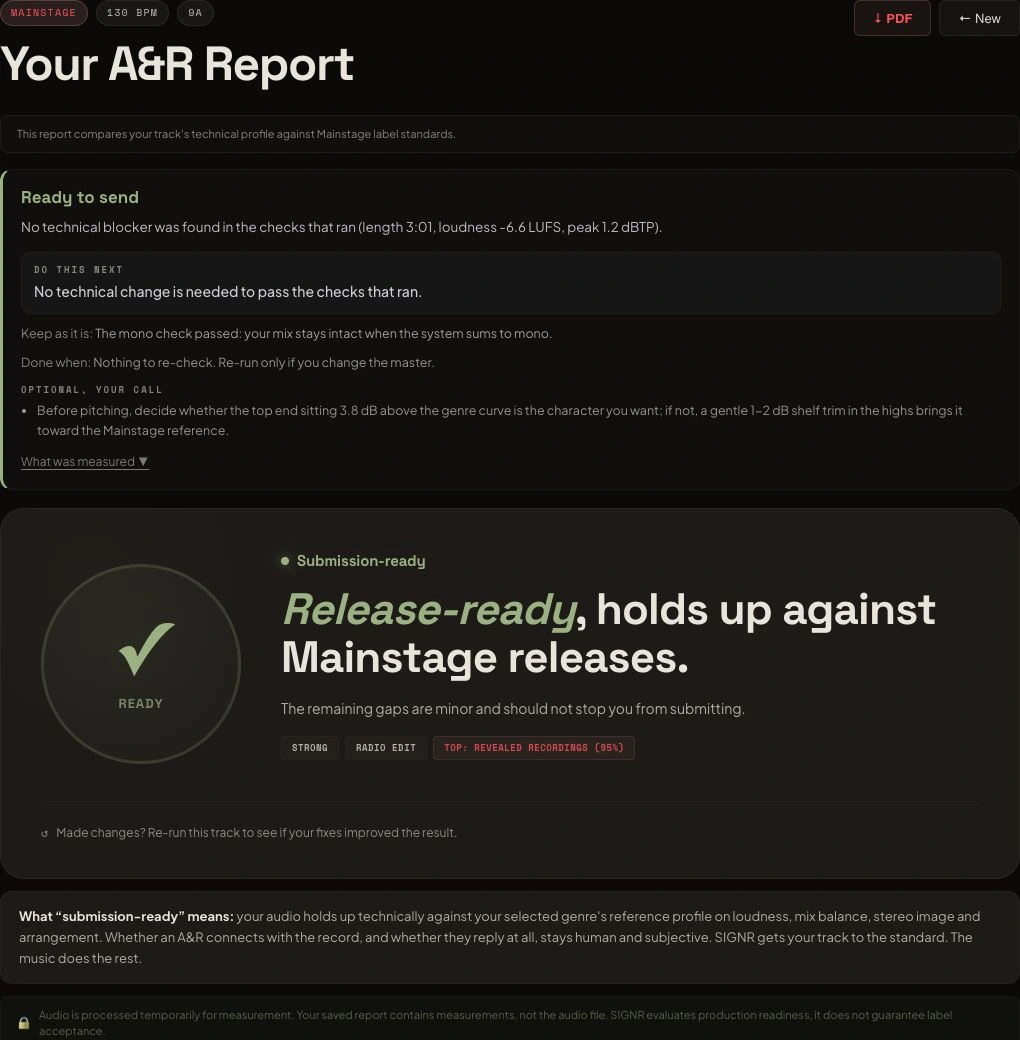
The verdict and what was measured
Technical readiness and the checks that ran, with optional creative choices. This is not a label acceptance decision.
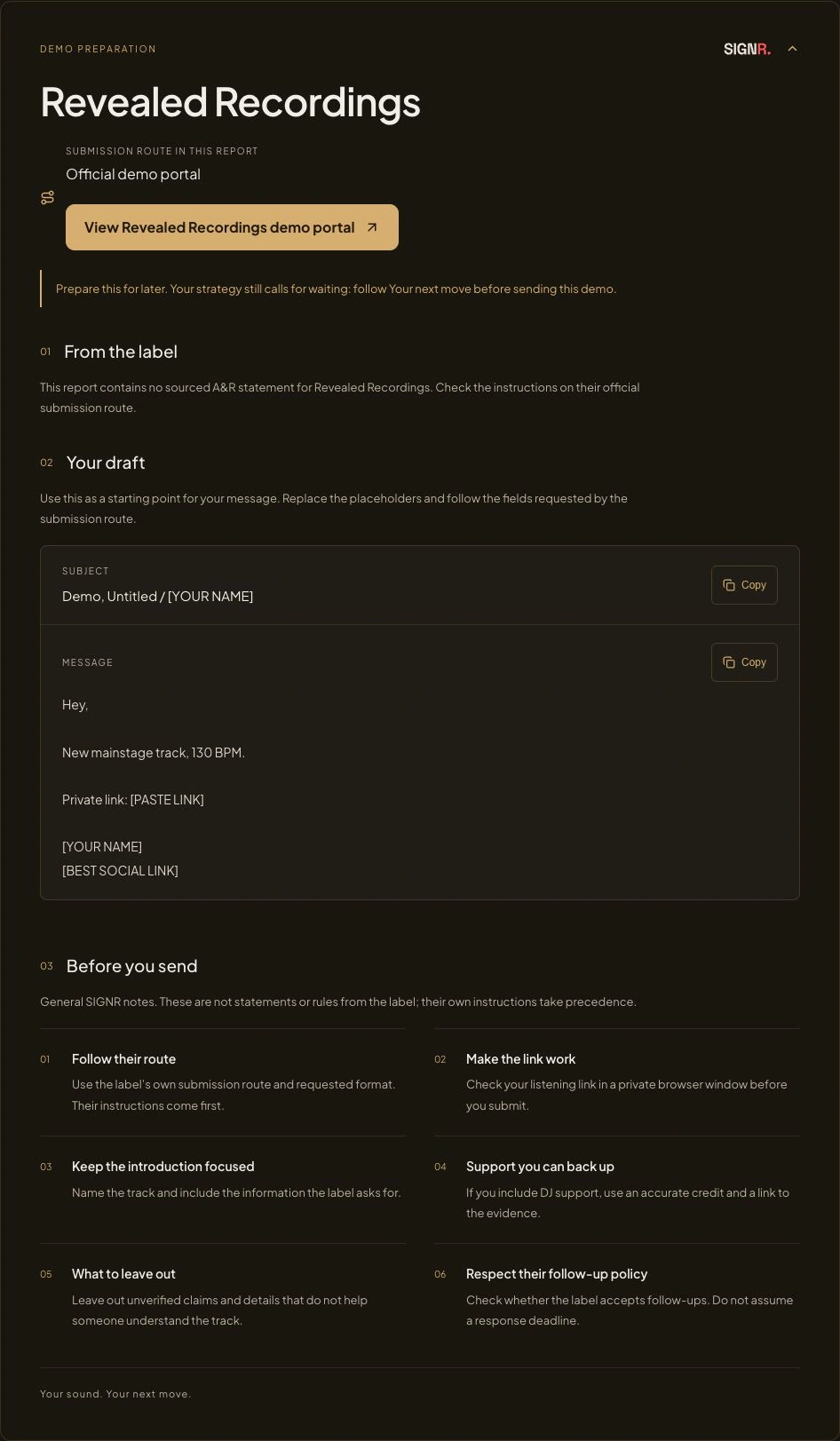
Prepare your demo
The official submission route, a message draft and practical notes, with the report’s strategic advice kept visible.
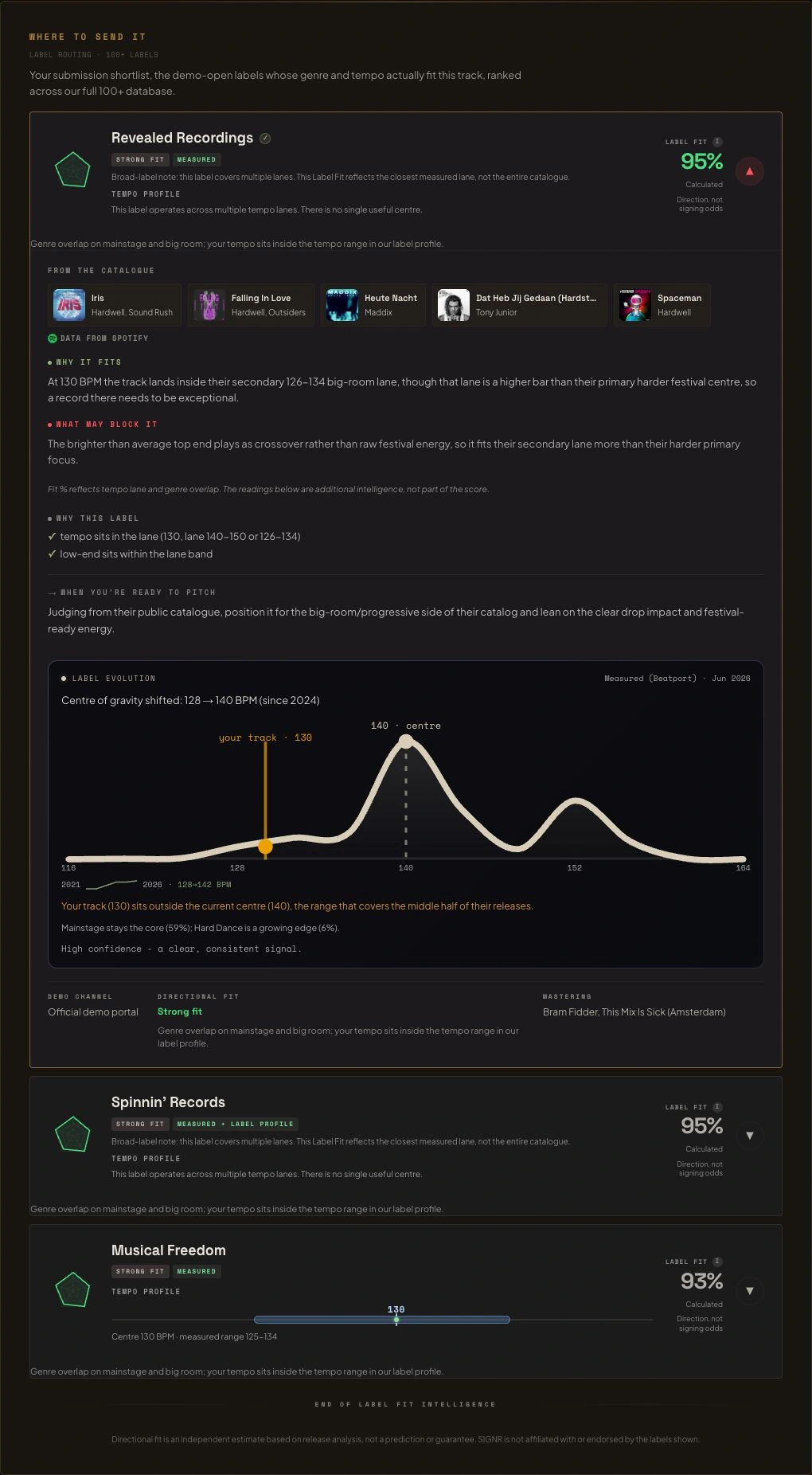
Your label shortlist
Label fit and the context behind it. Fit scores are direction, not signing odds or label endorsement.
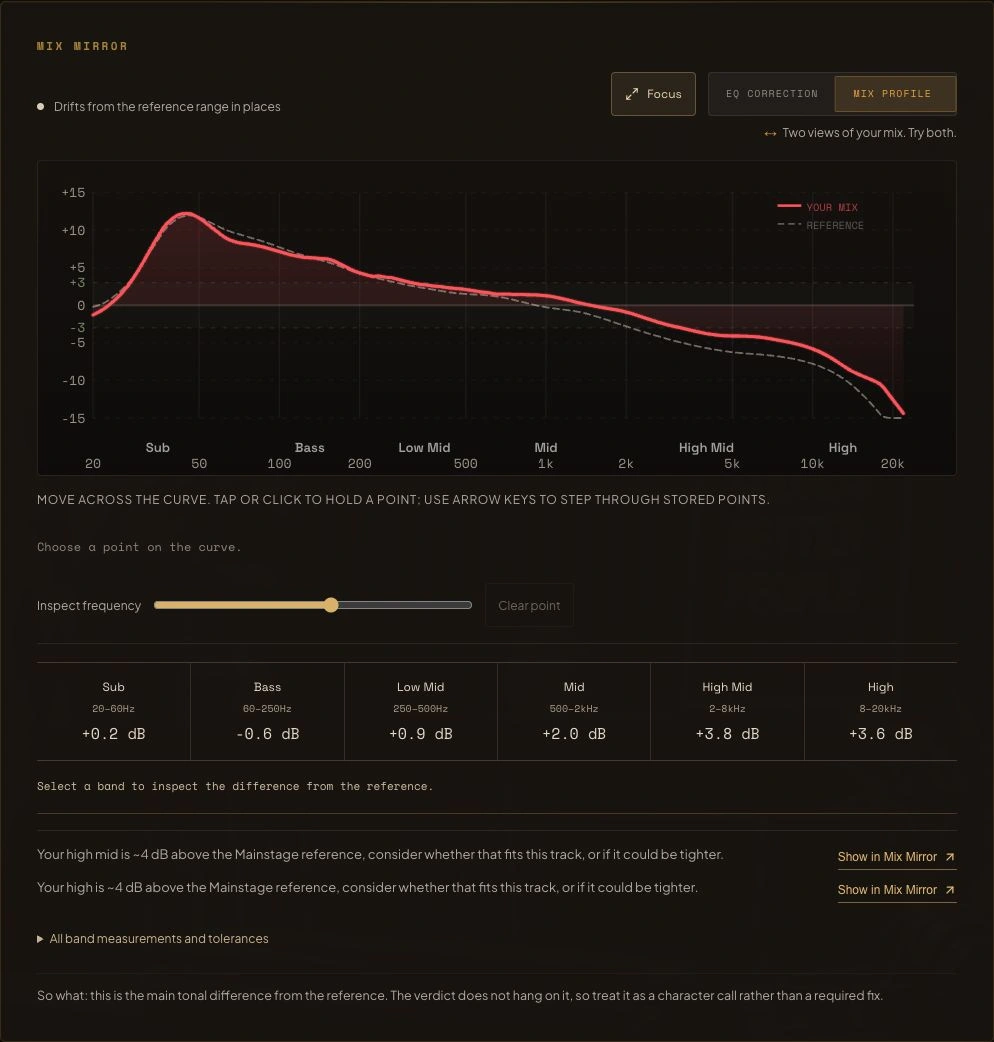
Mix Mirror, your balance beside the reference
Compare the track’s frequency balance with the genre reference. A difference is an observation, not an instruction.
Built by Dannic

Dannic is a Dutch DJ and producer who has released on Revealed, Spinnin’, Fonk and Protocol, and played festivals including Tomorrowland, Ultra and Creamfields.
He has been on both sides of the demo inbox: sending records for years, and later reviewing what came back. Producers keep asking him the same question, what do you think about this track.
SIGNR brings measurements, label research and AI-written assessments together. It does not know why a particular label passed on a demo. It gives producers findings they can investigate and a direction to explore.
SIGNR works alongside artistcoaching.nl, Joey’s producer community, podcast and coaching platform. The two cover different ground: Artist Coaching handles the business side, SIGNR reads the track.
SIGNR is independent and is not affiliated with or endorsed by any label it describes. Dannic releases music as an artist on labels that also appear in the label data; those relationships predate SIGNR.
Data policy source: Anthropic commercial API training policy. SIGNR privacy information.
Who SIGNR is for
- ›Producers finishing a demo or a mix who want to know what is actually holding it back.
- ›Producers preparing a release who want a second read before they send it anywhere.
- ›Producers researching a label direction, who want to know which catalogues their sound sits near.
SIGNR at a glance
Confirmed facts, safe to quote.
- Name
- SIGNR
- Category
- Track analysis and label intelligence for electronic music producers
- Founder
- Daan Romers, known as Dannic
- Who it is for
- Electronic music producers preparing a demo, a mix or a release
- What you get
- A free track check, and a full report with label direction, Mix Mirror, diagnostics, a next move and a downloadable PDF
- Label data
- 200+ label profiles inform label direction; a smaller calibrated set supports sonic comparison
- Price model
- Free track check without an account. EUR 9 for one full report plus one revision of the same track, one time, no subscription. Packs of 3 and 5 separate reports at EUR 19 and EUR 29.
- Website
- https://www.signr.live
- Press contact
- support@signr.live
Press material
Copy, images and logos, free to use for coverage of SIGNR.
Dannic built SIGNR after years on both sides of the demo inbox. SIGNR combines audio measurements, researched label context and AI-written assessments to help electronic music producers understand what needs work and choose their next step. Free preview; EUR 9 for a full report plus one revision of the same track. 200+ label profiles inform label direction. signr.live.
Dannic built SIGNR after years on both sides of the demo inbox. Why a good track can still be the wrong demo for a label. SIGNR helps electronic music producers investigate their mix, explore relevant labels and decide what to do next, including when they release independently. Code measures. Research adds context. AI assesses and explains. You decide. 200+ label profiles inform label direction; a smaller calibrated set supports sonic comparison. The report includes detailed mix feedback, Mix Mirror, label context and a PDF. A free preview comes first. EUR 9 includes the full report plus one revision of the same track to compare versions. Reports are generated automatically, without a personal listening session by Dannic. A label match is not a signing prediction.
Built by Dannic from years on both sides of the demo inbox, SIGNR helps electronic music producers understand what needs work in a track and which labels to explore. Audio measurements, researched context and AI-written assessments come together in one report. Start with a free preview at signr.live.
Logo


Everything on this page in one file: signr-press-kit.zip. Press contact: support@signr.live
Questions we get asked
Is my music used to train AI?
Your audio file is not sent to the report-writing AI. Measurements and the track details you provide are sent to Anthropic to generate your report. Anthropic says commercial API inputs and outputs are not used for training by default, with exceptions for feedback or permission to use data. Account-specific permissions and any manual reuse of SIGNR data have not been verified, so we cannot give an unconditional no-training promise for every data flow.
Do Dannic’s label relationships influence SIGNR?
Dannic has released music on labels that appear in SIGNR. The reviewed matching code uses genre, tempo and profile data, with no founder-relationship scoring input. Label profiles and genre rules still involve editorial choices; this is not proof that every comparison is free of bias.
Does SIGNR use AI?
Partly, and the report tells you which part. The measurements are computed from your audio by signal analysis, not by a language model. A model writes the interpretation, working from those measurements and the label research. Measured values, catalogue comparisons and written assessments are labelled separately so you can see which is which.
Can I upload a demo or an unfinished mix?
Yes, and that is the normal case. The report works from what the audio supports at that stage. If a track is too short or too unfinished for a part of the analysis, the report says that plainly and holds that part back.
Does a label match mean a label will sign my track?
No. A label match describes how your measured track relates to that label’s releases and stated direction. It is a reading of where your sound sits, not a prediction of any label decision. SIGNR has no role in what a label does with a submission.
Is every report personally reviewed by Dannic?
Dannic designed what SIGNR checks. Your report is generated automatically, without a personal listening session by Dannic. You make the creative decisions. Each label makes its own signing decisions.
Where does the label information come from?
Public sources: label pages and submission routes, interviews and public statements from label people, and release data. How much evidence exists differs per label, so the report shows the source and the date behind what it tells you, and stays quiet where there is nothing solid.